
Part of our Google Ads for Local Businesses guide.
This is a complete guide to Google Ads and Local Services Ads (LSA) for pest control companies. Most pest searches start with a sighting: mice in the kitchen, ants on the counter, bites from bed bugs or swarming termites. Homeowners want help fast, and the best customers stay on a recurring plan for years. This guide covers cost per lead, LSA vs Google Ads, setup, keywords, tracking, tools, challenges, checklists and bidding.
1. Pest control industry: data and cost per lead
Quick answer: Home services Search ads average about $8.33 per click and about $91 per lead (WordStream/LocaliQ 2026). Pest control LSA leads often cost around $25 to $60 (estimate). Because many customers sign recurring plans worth $400 to $800 or more a year, lifetime value matters more than the first visit.
Pest control mixes urgent one-off jobs (wasps, mice, bed bugs) with recurring quarterly plans and high-value termite work. Demand peaks in spring and summer, with rodent calls rising in fall. The best accounts track which leads became recurring customers, not just calls.
| Metric | Typical range |
|---|---|
| Search cost per click (home & home improvement) | About $8.33 (WordStream/LocaliQ 2026 benchmark) |
| Search conversion rate | About 8% |
| Search cost per lead | About $91 |
| Click-through rate | About 6.5% |
| Local Services Ads cost per lead | About $25 to $60 (estimate; varies by city and job type) |
| Typical job value | About $150 to $400 one-off; $400 to $800+ per year for plans (estimate) |
Estimate your budget with our Google Ads budget calculator (choose Pest Control).
Cost per booked customer: a worked example
Quick answer: Cost per booked customer = cost per lead ÷ close rate. On industry benchmarks, $1,500 a month in Search brings about 14 leads at $107 each; closing 45% gives about 6 new customers at roughly $250 each, while the same spend in Local Services Ads at about $35 a lead gives about 19 at $79 each.
| Step | Google Search (benchmark) | Local Services Ads |
|---|---|---|
| Monthly ad spend | $1,500 | $1,500 |
| Cost per lead | $107 ($8.33 per click, 8.05% conversion) | $35 (estimate) |
| Leads | 14 | 43 |
| Close rate (example) | 45% | 45% |
| Booked new customers | 6 | 19 |
| Cost per booked customer | $250 | $79 |
| Revenue at $600 each | $3,600 | $11,400 |
| Ad spend as % of revenue | 42% | 13% |
Revenue uses a $600 first-year value per customer (estimate).
Your ceiling per lead: if you aim to spend no more than 20% of a $600 customer on ads ($120) and you close 45%, you can pay up to about $54 per lead. The Search benchmark ($107) is above this ceiling but LSA (about $35) is below it, which is why LSA usually comes first for a pest control company, with Search kept tight on the best-paying jobs.
These are benchmark and example figures, not a promise. Swap in your own cost per lead, close rate and job value, or use the Google Ads budget calculator.
2. Which is best for pest control: LSA or Google Ads?
Quick answer: Use both. Pest control is an eligible Local Services Ads category with low lead costs and the Google badge. Add Google Search ads for termite, bed bug, rodent and recurring plan searches, where you want pest-specific ads and landing pages.
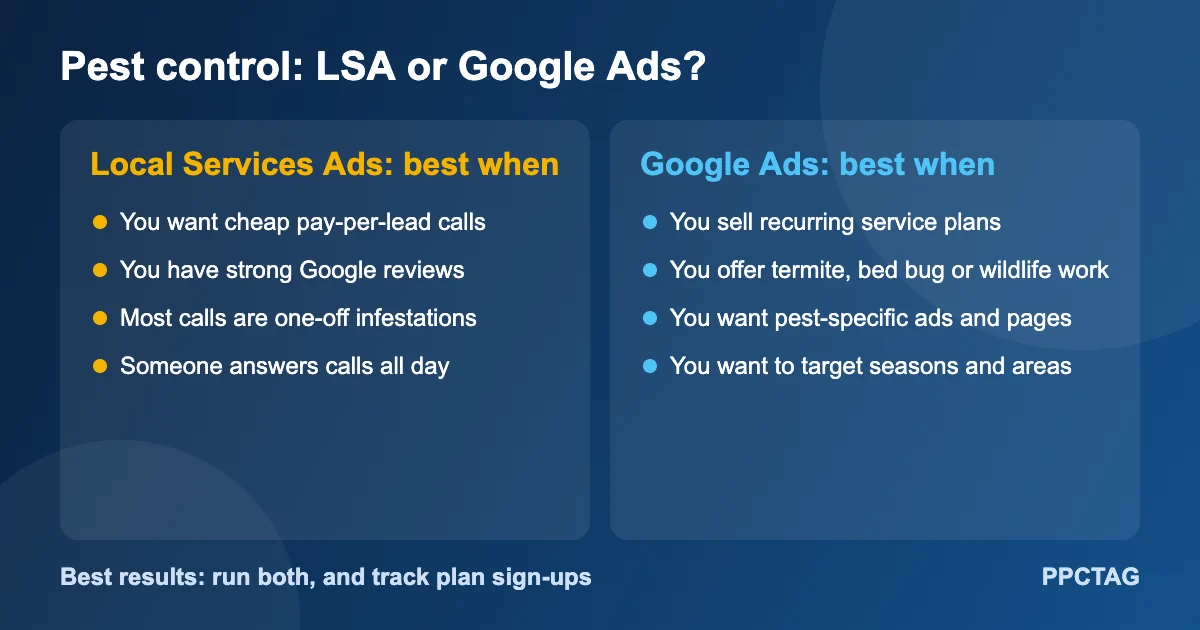
| Local Services Ads | Google Ads (Search) | |
|---|---|---|
| You pay for | Each lead | Each click |
| Keyword control | No, job types only | Yes, by pest and service |
| Landing pages | No, profile only | Pest-specific pages |
| Best for | General and urgent pest calls | Termites, bed bugs, plans |
| Setup time | 1 to 4 weeks | Same day |
3. How do you set up Local Services Ads for pest control?
Quick answer: Create a Local Services profile in the Pest control category, verify your Google Business Profile, pass background, pesticide licence and insurance checks, choose pest job types and ZIP codes, set hours and a weekly budget, and build reviews.
- Google Business Profile: matching details, photos of technicians and vehicles.
- Job types: switch on the pests you treat (ants, bed bugs, rodents, termites, wasps, wildlife).
- Verification: background checks, state pesticide applicator licence and insurance.
- Service area: ZIP codes on your route.
- Hours: match office hours.
- Budget: start with maximize leads.
- Reviews: ask after the first service and after each renewal.
4. How do you set up Google Ads for a pest control company?
Quick answer: Track calls and forms first, then build a Search campaign with ad groups by pest: general pest control, termites, bed bugs, rodents and mosquitoes. Use a 15 to 25 mile radius, $30 to $70 a day, and offer-led ads such as a free inspection or first-service price.
- Tracking first (sections 8 and 14).
- Ad groups: Pest control, Termite inspection and treatment, Bed bugs, Rodents, Mosquitoes.
- Location: 15 to 25 miles, presence targeting, matching your routes.
- Budget: $30 to $70 a day to start.
- Ads: “Licensed Local Exterminators”, “Free Termite Inspection”, “Same-Day Pest Service”.
- Assets: call, location, sitelinks by pest, promotion for first service.
- Landing pages: one per main pest, with plan pricing and reviews.
Example ads for a pest control company
Responsive search ads take up to 15 headlines (30 characters each) and 4 descriptions (90 characters each). Replace [City] with your city and keep within the limit.
| Headline | Characters |
|---|---|
| Pest Control in [City] | 22 |
| Licensed Local Exterminators | 28 |
| Free Termite Inspection | 23 |
| Same-Day Pest Service | 21 |
| Bed Bug Treatment Experts | 25 |
| Description | Characters |
|---|---|
| Ants, mice or roaches? Licensed technicians and pet-safe options. Call today. | 77 |
| Free termite inspection and clear treatment plans. Quarterly protection available. | 82 |
Only use claims that are true for your business (prices, guarantees, response times), and add call, location, sitelink and callout assets.
5. What is best for pest control: Performance Max, Search or Display?
Quick answer: Search is the best main campaign because people search for a specific pest. Add Performance Max for Maps and seasonal reach once you have 30 or more conversions a month. Use Display only for small remarketing to quote visitors.
| Campaign type | Use it when | Watch out for |
|---|---|---|
| Search | Main campaign | DIY and product searches |
| Performance Max | 30+ conversions a month | Low-quality leads; import plan sign-ups |
| Display | Small remarketing only | Low-intent clicks |
| LSA | Alongside Search | Wrong-pest and out-of-area leads |
$10 Audit Report
Find out what is wasting money in your pest control company Google Ads
I review your search terms, tracking, Local Services Ads and targeting, and send a clear list of what to fix first. No contract.
6. Which 10 keywords generate pest control leads?
Quick answer: The best pest control keywords include pest control near me, exterminator near me, termite inspection, bed bug exterminator and rodent control. Termite and bed bug terms bring the highest job values.
| # | Keyword | Intent |
|---|---|---|
| 1 | pest control near me | Ready to book |
| 2 | exterminator near me | Ready to book |
| 3 | termite inspection | High value |
| 4 | termite treatment | High value |
| 5 | bed bug exterminator | Urgent, high value |
| 6 | rodent control near me | Urgent |
| 7 | mouse exterminator | Urgent |
| 8 | cockroach exterminator | Urgent |
| 9 | mosquito control service | Seasonal, recurring |
| 10 | pest control service plans | Recurring value |
7. Which keywords should pest control companies avoid?
Quick answer: Block DIY, product, job and pet-flea searches, and anything about pest identification only. People buying sprays or researching bugs rarely book a technician.
- DIY and products: spray, bait, trap, powder, how to get rid of, home remedy, Home Depot, Amazon
- Jobs and licensing: jobs, salary, exterminator license, training
- Research only: pictures, identification, life cycle, bite pictures
- Wrong service: flea medicine for dogs, vet, plant pests, lice treatment
Estimate Your Google Ads Budget
8. What is the best way to track pest control leads?
Quick answer: Track calls, quote forms and LSA leads, then record which became first services and recurring plans in your pest control software, and import those with values. Plan sign-ups are the conversion that matters most.
- Call tracking on the website and call assets in ads.
- Quote and inspection forms tracked.
- LSA leads reviewed weekly; dispute wrong-pest or out-of-area leads.
- Import first services and plan sign-ups with annual value.
9. Which booking and lead tracking tools can pest control companies use?
Quick answer: Popular pest control tools include FieldRoutes, PestPac, GorillaDesk and Jobber for scheduling, routing and recurring billing, plus CallRail for call tracking and Google Tag Manager with GA4 for forms.
| Tool | Type | Useful for ads |
|---|---|---|
| FieldRoutes | Pest control software | Plans, routes, lead sources |
| PestPac | Pest control software | Recurring revenue reporting |
| GorillaDesk / Jobber | Field service software | Online booking and invoices |
| CallRail | Call tracking | Calls by keyword |
| Google Tag Manager + GA4 | Tracking | Form and click-to-call conversions |
Check each tool’s current features and pricing before you choose.
10. What are the biggest LSA challenges for pest control, and how do you fix them?
Quick answer: The main LSA challenges are leads for pests you do not treat, price shoppers wanting one cheap spray, seasonal budget limits and competitors with more reviews. Fix them with tight job types, plan-first sales scripts, seasonal budgets and a review routine.
| LSA challenge | Solution |
|---|---|
| Leads for pests you do not treat | Switch off those job types; dispute invalid leads |
| One-off price shoppers | Sales script that offers a plan with the first visit |
| Budget runs out in peak season | Raise budget in spring and summer |
| Competitors with more reviews | Ask after the first service and renewals |
| Leads off your routes | Trim ZIP codes |
11. What are the biggest Google Ads challenges for pest control, and how do you fix them?
Quick answer: The main Google Ads challenges are DIY clicks, national brands bidding high, seasonal swings and judging success by first-visit revenue. Fix them with negatives, pest-specific ad groups and pages, seasonal budgets and importing plan values.
| Google Ads challenge | Solution |
|---|---|
| DIY and product clicks | Negative list (section 7) |
| National brands bid high | Pest-specific, local ad copy and pages |
| Seasonal swings | Shift budget by pest season |
| Valuing only the first visit | Import annual plan values |
| One landing page for all pests | Page per main pest |
12. Checklist before turning on LSA
- Google Business Profile verified
- Background, pesticide licence and insurance checks approved
- Only pests you treat switched on
- ZIP codes match routes
- Hours match when someone answers
- Lead alerts on; weekly budget set
- Review request process ready
13. Checklist before turning on a Google Ads campaign
- Calls and forms tracked and tested
- Ad groups and landing pages per pest
- Negative keyword list added
- Radius matches service routes
- Call, location, sitelink and promotion assets added
- Plan pricing shown on pages
- Bidding and daily budget chosen (section 15)
14. Conversion tracking ideas for pest control Google Ads
Quick answer: Track calls over 60 seconds, inspection and quote forms and LSA leads as primary conversions, then import first services and recurring plan sign-ups with their annual value so Google bids for customers who stay.
- Calls from ads of 60 seconds or more.
- Website calls from tracking numbers.
- Inspection or quote forms.
- First service booked, imported.
- Plan sign-up with annual value, imported.
- Enhanced conversions for leads.
15. Bidding ideas for LSA and Google Ads
Quick answer: For Search, start with Maximize Conversions, move to target CPA after 30 conversions a month and to value-based bidding once plan values are imported. For LSA, start with maximize leads, then set a target cost per lead and raise budgets in peak season.
| Stage | LSA (pay-per-lead) | Google Ads (Search) |
|---|---|---|
| Launch | Maximize leads | Maximize Conversions |
| Steady volume | Target cost per lead | Target CPA |
| Mature | Seasonal budgets by pest | Value-based bidding with plan values |
Change targets 10 to 20% at a time and wait 1 to 2 weeks between changes.
16. KPIs to watch every week
- Cost per lead and cost per new customer
- Plan sign-up rate
- Revenue per customer over 12 months
- Lead share by pest
- Search terms and new negatives
- Review count vs competitors
FAQs
How much do Google Ads cost for pest control companies?
Home services Search ads average about $8.33 per click and about $91 per lead (WordStream/LocaliQ 2026). Pest control LSA leads are often cheaper, around $25 to $60 (estimate). Most local companies start at $30 to $70 a day.
Can pest control companies use Local Services Ads?
Yes. Pest control is an eligible Local Services Ads category in the US. You must pass Google’s checks, which can include background and licence verification, and you pay per lead.
Should pest control companies use LSA or Google Ads?
Use both. LSA brings cheap general pest calls with the Google badge, and Google Search ads let you target termites, bed bugs, rodents and recurring plans with pest-specific pages.
What are the best keywords for pest control ads?
Pest control near me, exterminator near me, termite inspection, bed bug exterminator and rodent control are among the best. Block DIY, spray and identification searches.
How do I get more recurring pest control customers from ads?
Offer a plan on the first call, show plan pricing on landing pages and import plan sign-ups with annual value into Google Ads so bidding favours customers who stay.
How long do pest control Google Ads take to work?
Calls usually start in the first week. Smart bidding needs about 4 to 6 weeks of conversion data, and LSA verification can take 1 to 4 weeks.
Get a Google Ads & LSA Audit for Your Pest Control Company
I will review your campaigns, search terms, tracking and Local Services Ads setup, and send a clear report showing what to fix first. It costs $10 and there is no long-term contract.
More industry guides: tree services, junk removal, garage door companies, pressure washing, home inspectors, painting contractors.