
Part of our Google Ads for Local Businesses guide.
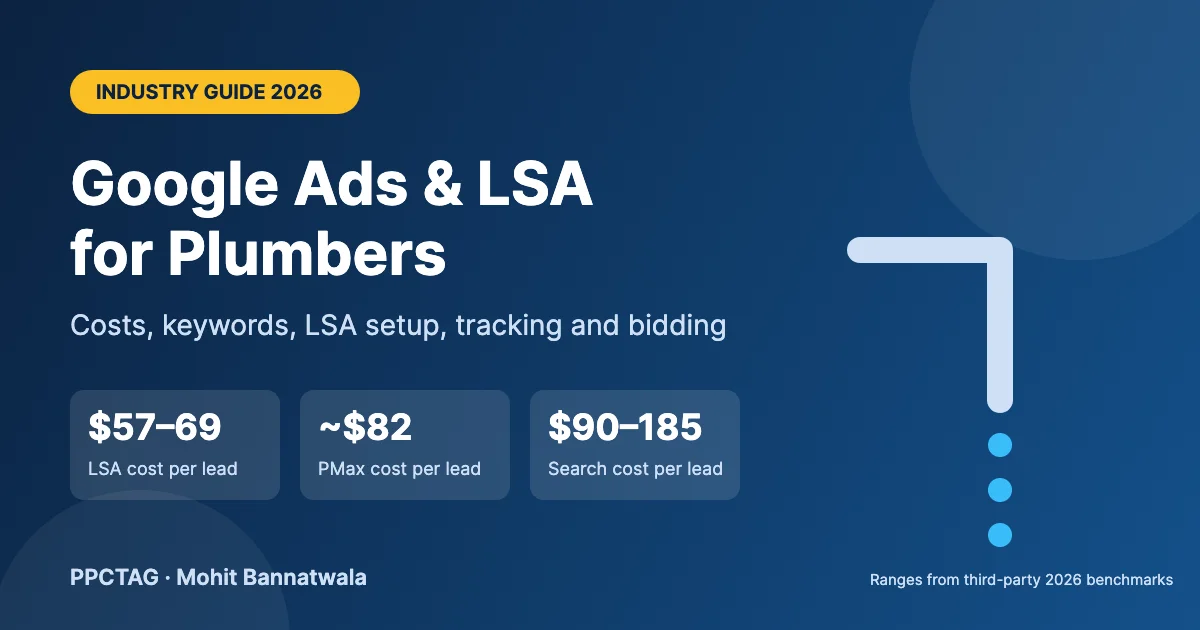
This is a complete 2026 guide to Google Ads for plumbers and Local Services Ads (LSA). When a pipe bursts or a water heater fails, homeowners search Google and call within minutes, usually one of the first two or three plumbers they see. Being in those top spots is the difference between a full schedule and a quiet week.
Plumbing is also one of the most expensive trades to advertise, so small mistakes cost real money. This guide covers 2026 cost benchmarks, LSA vs Google Ads, setup, keywords, negatives, tracking, tools, common problems, checklists and bidding.
1. How much do Google Ads cost for plumbers?
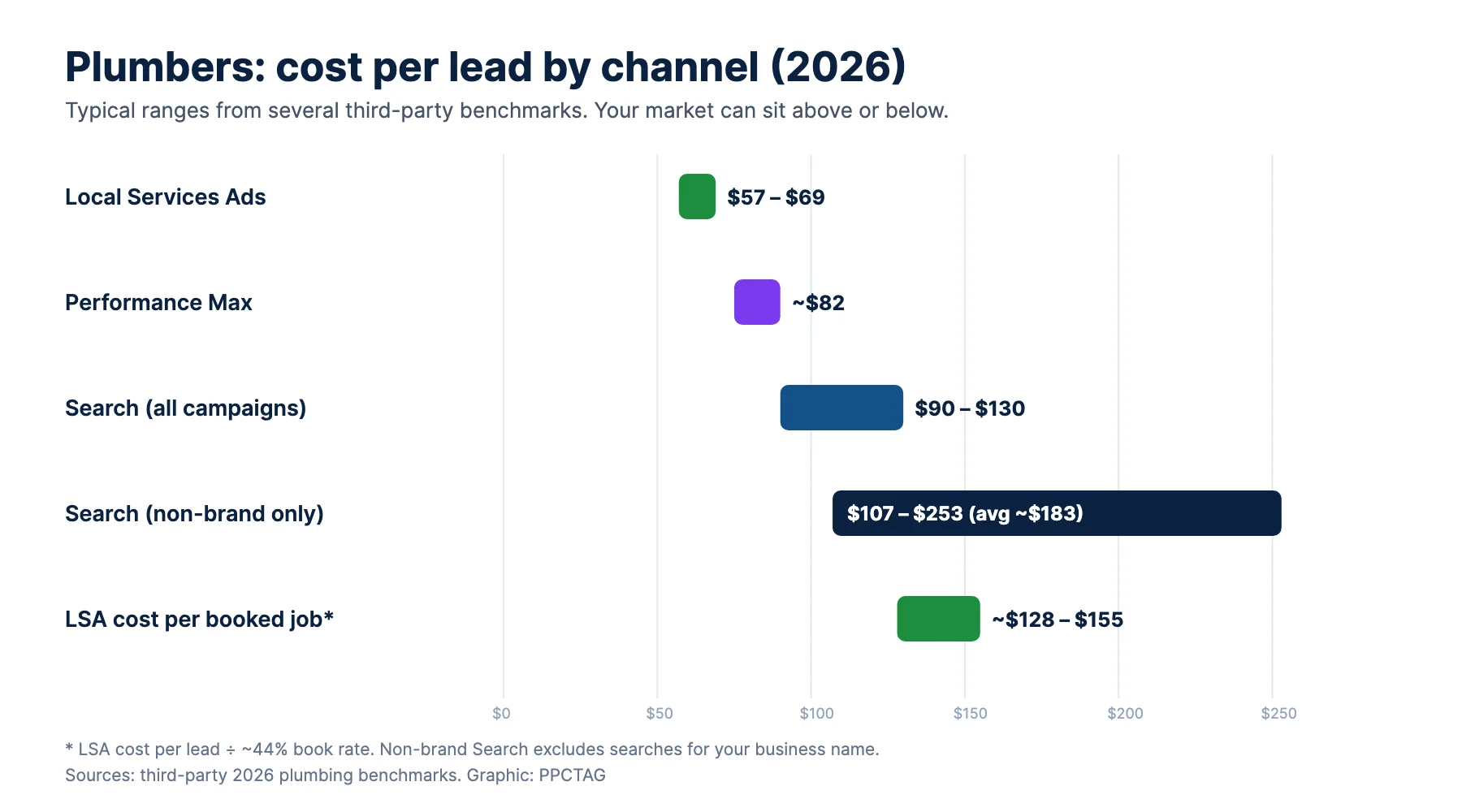
Quick answer: Plumbing is one of the most expensive home-service trades on Google. Third-party 2026 benchmarks put Local Services Ads at about $57 to $69 per lead, Performance Max around $82 and Search campaigns roughly $90 to $130 per lead, with non-branded searches costing more. Clicks average around $10, and emergency terms cost far more.
| Metric (third-party 2026 benchmarks) | Plumbing |
|---|---|
| Average Search cost per click | About $10.49 (emergency terms often $30+) |
| Search click-through rate | About 4.97% |
| Search conversion rate | About 7.63% |
| Search cost per lead (all campaigns) | About $90 to $130 |
| Search cost per lead (non-branded searches only) | About $107 to $253, average around $183 |
| Performance Max cost per lead | About $82 |
| Local Services Ads cost per lead | About $57 (February) to $69 (May), with a book rate around 44% |
| Average LSA ticket | About $1,714 |
Who searches: homeowners with an urgent problem (leaks, clogs, no hot water), people planning a job (water heater replacement, repiping, bathroom remodel plumbing) and property managers. Seasonality: frozen and burst pipes in winter, water heater failures in cold months, sewer and drain calls after heavy rain. Job value: a drain call may be a few hundred dollars, while water heater installs and repipes run into the thousands, so not every lead is worth the same.
Why the numbers vary so much: benchmark studies measure different things. Some count only non-branded searches (people who do not know your company yet), which cost the most. Others include brand searches, which are cheap. Costs also change by season, city and job type, so treat these as ranges and compare against your own account.
Cost per booked job: a worked example
- LSA: $57 to $69 per lead ÷ a book rate of about 44% ≈ $128 to $155 per booked job.
- Search: at about $110 per lead and an illustrative 35% book rate, that is roughly $315 per booked job. Non-branded searches cost more per lead, so keep Search focused on high-value jobs.
- On a $1,714 average ticket, both can be profitable. Search must be kept tight on high-value jobs.
Plan a starting budget with our Google Ads budget calculator. Benchmarks are averages; your city, job mix and answer rate matter more.
Cost per lead by job type: repair vs installation vs replacement
A single “cost per lead” hides a big difference. In plumbing, repair leads are usually the cheapest and book fastest, but the jobs are small. Installation and replacement leads cost more because people research longer and compare quotes, but each job is worth far more. Judge every job type on cost per booked job and job value, not on cost per lead alone.
| Job type | Example jobs | Typical job value (estimate) | Cost per lead tends to be | Why | How to run it |
|---|---|---|---|---|---|
| Repair (urgent) | Leaks, clogged drains, toilet and faucet repair, burst pipes | $150 – $600 | Lowest | Urgent searches convert fast; many calls book the same day | LSA plus an Emergency Search campaign; staff the phones |
| Installation | Water heater, tankless, sump pump, fixture installs | $1,000 – $4,000 | Medium | People compare a few quotes before booking | Own Search campaign and landing page; show financing and warranty |
| Replacement / major work | Repiping, sewer line replacement, water heater replacement | $2,500 – $15,000+ | Highest | Fewer searches, longer decisions, more quotes | Separate budget; judge it on cost per booked job, not cost per lead |
Work out the most you can pay per lead for each job type: average job value × close rate × the share of revenue you can spend on ads.
- drain cleaning: $400 × 40% × 15% ≈ $24 per lead
- water heater replacement: $2,500 × 30% × 15% ≈ $113 per lead
So a replacement lead that costs three or four times more than a repair lead can still be the better deal. Run repair, installation and replacement as separate campaigns or ad groups with their own budgets, and import booked jobs with their values so Smart Bidding learns which leads are worth more. Job values above are rough estimates and vary by market.
2. Which is best for plumbers: LSA or Google Ads?
Quick answer: Plumbing is eligible for Local Services Ads, and for most plumbers LSA should come first because it is the cheapest lead source and shows the Google Verified badge. Add Search campaigns for high-value jobs such as water heaters, repiping and sewer lines, where you can control keywords, pages and bids.
| Local Services Ads | Google Search Ads | |
|---|---|---|
| You pay for | Valid leads (calls, messages, bookings) | Clicks |
| Typical cost (2026) | ~$57 to $69 per lead | ~$10 per click, ~$90 to $130 per lead |
| Control | Job types, service area, hours, budget | Keywords, ads, pages, bids, schedule |
| Trust | Google Verified badge | Reviews, assets and landing page |
| Best for | Everyday service calls, emergencies | Water heaters, repipes, sewer, commercial |
3. How do you set up Local Services Ads for plumbers?
Quick answer: Link a verified Google Business Profile, pass background checks for owners and plumbers who visit homes, upload your plumbing license and insurance, choose only the job types you want, set service ZIP codes and real answering hours, then start with a modest budget and watch lead quality.
- Google Business Profile: verified, with the same name as your license and insurance, and steady new reviews.
- Sign up at g.co/localservices and choose plumbing.
- Verification: background checks for the business, owners and field plumbers, plus license and insurance. See how to get the Google Verified badge.
- Job types: turn on drains, leaks, water heaters, toilets, sewer and so on, and turn off anything you do not do.
- Service area: ZIP codes your trucks reach within your promised response time.
- Hours: only when someone answers live. Check how missed calls are charged in LSA missed call charges.
- Budget: start small, then raise it once leads are steady.
- Where leads live now: plumbing is in the first group of LSA accounts moving into Google Ads as pay-per-lead Performance Max campaigns. Read what changes in the move.
Local Services Ads help
Want more plumbing jobs from LSA?
I set up and optimise LSA job types, service areas and lead disputes for plumbing companies.
4. How do you set up Google Ads for a plumbing company?
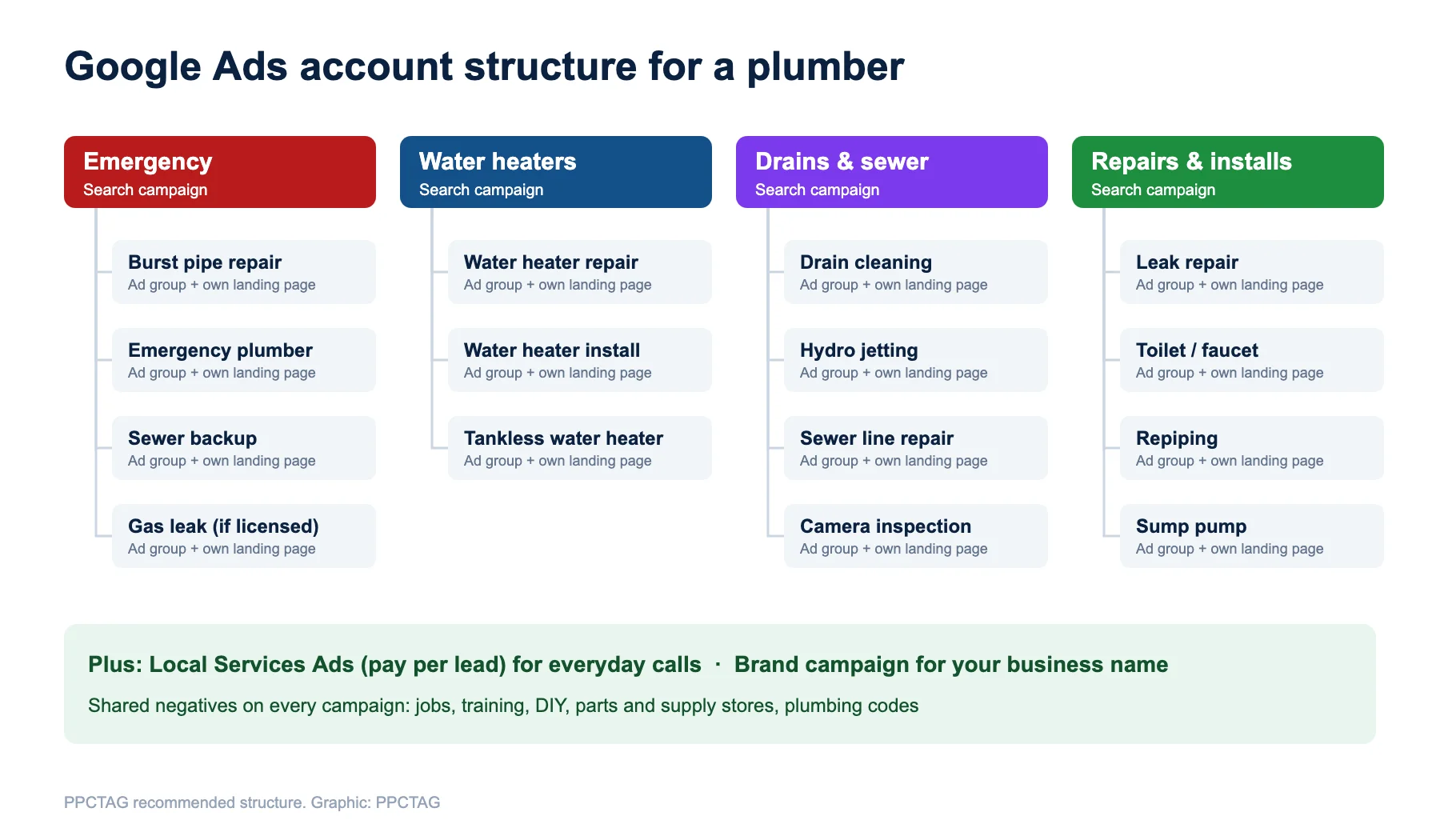
Quick answer: Set up call and form tracking first. Then build Search campaigns by service (emergency, water heaters, drains and sewer, repairs), with one ad group and landing page per service, location option set to Presence, Search partners and Display off, strong assets, and an ad schedule that matches when calls are answered.
- Tracking first: calls from ads, calls from the website and forms (section 8).
- Campaigns: Emergency, Water heaters, Drains & sewer, Repairs & installs, and a small Brand campaign. Split them so expensive emergency clicks do not eat the budget for planned work.
- Ad groups: one per service with 5 to 15 close keywords in phrase and exact match.
- Locations: your service area with the location option set to “Presence”.
- Ad copy angles: speed, upfront pricing, licensed and insured, warranty. Example headlines: “24/7 Emergency Plumber”, “Water Heater Installed Today”, “Upfront Plumbing Prices”.
- Assets: call, location, 6+ sitelinks, callouts and a Services structured snippet. See our Google Ads assets guide.
- Landing pages: one per main service, with click-to-call, a short form or online booking, license number, reviews and real photos.
- Ad schedule: run 24/7 emergency ads only if someone answers at night.
Do not use call-only ads: Google stopped new ones in February 2026 and existing ones stop serving in February 2027. Use responsive search ads with call assets instead.
5. Performance Max vs Search vs Display for plumbers
Quick answer: Search first, because it captures people who need a plumber now. Performance Max can bring cheaper leads once conversion tracking is solid, but watch lead quality and exclude your brand. Display is mainly for remarketing high-value jobs like water heaters and repiping.
| Campaign type | Use when | Watch out for |
|---|---|---|
| Search | Always, for urgent and high-value services | High CPCs; review search terms weekly |
| Performance Max | Tracking is solid and you have 30+ conversions a month | Spam forms, brand cannibalisation, low-quality placements |
| Display / remarketing | Promoting water heater or repipe offers to past visitors | Low intent; keep budget small |
If AI Max for Search is on, check its search terms and landing pages; see our AI Max guide.
6. Which 10 keywords generate plumbing leads?
Quick answer: The best plumbing keywords show someone needs a plumber now or is planning a paid job: “plumber near me”, “emergency plumber”, water heater, drain, sewer and burst pipe searches. Use phrase and exact match, and give high-value services their own ad groups and landing pages.
| # | Keyword | Intent | Match type |
|---|---|---|---|
| 1 | plumber near me | Hire now | Phrase / exact |
| 2 | emergency plumber | Urgent | Phrase |
| 3 | water heater replacement | High value | Phrase |
| 4 | tankless water heater installation | High value | Phrase |
| 5 | drain cleaning service | Service call | Phrase |
| 6 | sewer line repair | High value | Phrase |
| 7 | burst pipe repair | Urgent | Phrase |
| 8 | leak detection | Service call | Phrase |
| 9 | repipe house cost | Planned, high value | Phrase |
| 10 | commercial plumber | Business | Phrase (own campaign) |
7. Which keywords should plumbers avoid?
Quick answer: Block searches from job seekers, students, DIYers, parts shoppers and people looking for services you do not offer. A shared negative keyword list on every campaign, reviewed against your search terms each week, usually saves a large share of wasted plumbing spend.
- Jobs and training: plumber jobs, salary, apprenticeship, plumbing school, license exam
- DIY and research: how to, DIY, unclog drain yourself, plumbing code, youtube
- Products and stores: home depot, lowes, ferguson, parts, fittings, wholesale
- Wrong service: pool, irrigation, septic pumping (unless you offer it), appliance repair
- Price-only: free, cheap (test carefully)
- Utilities: water bill, water company, city water
Review search terms weekly for the first month. Track AI Max matches with search_term_matchtype.
Free Google Ads audit
Paying for the wrong plumbing searches?
I check your search terms, negatives and tracking, and send a clear list of what to fix first.
8. What is the best way to track plumbing leads?
Quick answer: Track every lead source: calls from ads, calls from the website through a tracking number, forms and online bookings. Pass the gclid into your forms and booking tool, mark LSA lead outcomes, and import booked jobs and revenue back into Google Ads so bidding learns which searches bring paying customers.
- Call assets and website call tracking (dynamic number insertion)
- Form and online booking confirmations as conversions
- gclid saved in hidden form fields or your booking software
- LSA lead status updated (booked, archived, disputed)
- Offline conversion imports for booked and completed jobs with revenue
More in our call tracking dashboard guide.
9. Which booking and lead-tracking tools can plumbers use?
Quick answer: Most plumbing companies run on field service software such as ServiceTitan, Housecall Pro, Jobber, FieldEdge or Workiz. Pair it with call tracking like CallRail or WhatConverts and Google Tag Manager with GA4, so every ad lead can be followed through to a booked and paid job.
| Tool | Type | Useful for ads |
|---|---|---|
| ServiceTitan | Field service software (larger shops) | Job and revenue data for offline conversion imports; LSA booking integration |
| Housecall Pro | Field service software (small to mid-size) | Online booking, LSA booking integration, marketing reporting |
| Jobber | Field service software | Online booking, quotes and client hub |
| FieldEdge / Workiz | Field service software | Dispatch, job tracking, call tracking (Workiz) |
| CallRail / WhatConverts | Call tracking | Calls per keyword, recordings, Google Ads integration |
| Google Tag Manager + GA4 | Website tracking | Form, booking and click-to-call conversions |
Features and prices change often; check each vendor before choosing.
10. What are the biggest LSA challenges for plumbers?
Quick answer: The most common LSA problems for plumbers are low-value small jobs, spam or wrong-service leads, missed after-hours calls and leads from too far away. Most are fixed by tightening job types, ZIP codes and hours, answering fast and disputing invalid leads.
| Challenge | Solution |
|---|---|
| Low-value drain and small repair leads | Turn off unwanted job types and set a target cost per lead |
| Charged for wrong-service or spam leads | Dispute invalid leads quickly with notes |
| Missed calls after hours | Set real answering hours or use an answering service |
| Ads show far from your base | Tighten ZIP codes to your response radius |
| Few leads despite budget | More recent reviews, fast responses and correct categories |
11. What are the biggest Google Ads challenges for plumbers?
Quick answer: The biggest Google Ads problems for plumbers are expensive emergency clicks, DIY and job-seeker searches, untracked calls and sending every ad to the homepage. Separate campaigns, strong negatives, proper call tracking and one landing page per service fix most of them.
| Challenge | Solution |
|---|---|
| Very high emergency CPCs | Separate emergency campaign with its own budget and schedule |
| Clicks from DIY and job seekers | Strong shared negative lists and weekly search term reviews |
| Calls not tracked | Call assets plus website call tracking and form tracking |
| Sending all ads to the homepage | One landing page per service |
| Bidding for page views or clicks | Only real leads as Primary conversions |
| Broad match bringing poor leads | Start phrase and exact; add broad only with Smart Bidding and solid tracking |
12. Checklist before turning on LSA
Quick answer: Before turning on LSA, make sure your Business Profile is verified, license and insurance names match, every field plumber has passed background checks, job types and ZIP codes are right, and someone will answer every call during your ad hours.
- Google Business Profile verified and linked
- License and insurance names match the business name
- Background checks complete for every field plumber
- Job types and ZIP codes reviewed
- Hours match when calls are answered live
- Weekly or daily budget and target cost per lead set
13. Checklist before turning on Google Ads
Quick answer: Before turning on Google Ads, test every conversion, set the location option to Presence, turn off Search partners and Display, apply negatives, add all key assets, and make sure each main service has its own fast landing page with click-to-call.
- Call, form and booking conversions tested
- Location option set to Presence; Search partners and Display off
- Shared negative keyword lists applied
- Call, location, sitelink, callout and snippet assets added
- One landing page per main service, fast on mobile
- Emergency campaign scheduled only when phones are staffed
14. Conversion tracking ideas for plumbing Google Ads
Quick answer: Count only real leads (longer calls, forms, bookings) as Primary conversions, give big jobs higher values, and import booked and completed jobs from your field service software. That teaches Smart Bidding which searches bring paying customers, not just calls.
- Primary: calls from ads over 60 seconds, website calls, forms and online bookings.
- Secondary: clicks on the phone number, directions, page views.
- Values: assign rough values by service (for example water heater higher than drain cleaning) so Smart Bidding favours big jobs.
- Offline imports: send booked and completed jobs from your field service software back to Google Ads.
- Enhanced conversions for leads: improves matching when forms are submitted.
15. Bidding ideas for LSA and Google Ads
Quick answer: Start with Maximize leads on LSA and Maximize Conversions on Search, then move to a target cost per lead or Target CPA once you have about 30 leads a month. Later, bid on job value using offline imports. Change targets only 10 to 20% at a time.
| Stage | LSA | Google Ads Search |
|---|---|---|
| Launch (weeks 1-4) | Maximize leads with a modest budget | Maximize Conversions or Manual CPC on emergency terms |
| Steady (30+ leads a month) | Set a target cost per lead | Target CPA near your real cost per lead |
| Mature | Raise budget in busy seasons | Value-based bidding with offline job values |
Change targets by 10 to 20% at a time and wait one to two weeks between changes.
16. Which KPIs should plumbers watch every week?
Quick answer: Every week, check cost per lead and cost per booked job, answer rate, booked revenue from ads, impression share on emergency terms, wasted spend in search terms and LSA disputes. These show problems early, before a whole month of budget is spent.
- Cost per lead and cost per booked job, by campaign and LSA
- Answer rate and missed calls
- Booked jobs and revenue from ads
- Search impression share on emergency terms
- Wasted spend in search terms
- LSA disputed and credited leads
For the full method, see the Google Ads optimization process.
17. FAQs
How much do Google Ads cost for plumbers?
Third-party 2026 benchmarks put plumbing at about $10 per search click, roughly $90 to $130 per Search lead (more for non-branded searches), about $82 per Performance Max lead and about $57 to $69 per Local Services Ads lead. Emergency terms cost much more, and your city and job mix change the numbers.
Are Local Services Ads worth it for plumbers?
For most plumbers, yes. LSA is usually the cheapest lead source, you pay per lead rather than per click, and you get the Google Verified badge. Keep job types and service areas tight and dispute invalid leads.
Should plumbers use Performance Max?
Only after call and form tracking is reliable and you have steady conversions. Performance Max can lower cost per lead, but watch for spam forms and exclude your brand name so it does not take credit for people already looking for you.
What are the best keywords for plumbing Google Ads?
Plumber near me, emergency plumber, water heater replacement, tankless water heater installation, drain cleaning, sewer line repair and burst pipe repair are strong lead keywords. Add negatives for jobs, training, DIY and parts searches.
How do I track which ads bring plumbing jobs?
Use call assets, website call tracking and form tracking, save the gclid with each lead in your field service software, and import booked jobs and revenue back into Google Ads as offline conversions.
What changed for plumbing ads in 2026?
Local Services Ads for plumbing started moving into Google Ads as pay-per-lead Performance Max campaigns in August 2026, the Google Verified badge replaced Google Guaranteed, and call-only ads can no longer be created.
Get a Google Ads & LSA Audit for Your Plumbing Business
I review your Google Ads and Local Services Ads accounts and send a clear list of what to fix first.
More industry guides: HVAC, electricians, roofing.
Sources
- Google Verified Badge: How to Get It
- LSA to Performance Max: What Changes for Local Services Ads
- Google Ads Extensions (Now Assets): 2026 Guide
- Google Ads Help: Supported business verticals for Performance Max with pay-per-lead goals
Cost figures are third-party 2026 plumbing benchmarks and are averages, not guarantees.