Google posted six Google Ads policy updates in November 2026. Most are clarifications rather than brand-new rules, but two of them close gaps that some advertisers were using: you can no longer target people by their interest in prohibited categories, and AI-made ads that impersonate a public figure are not allowed even when the ad says it was made with AI.
There is also good news for two groups that local marketers work with: telemedicine providers in the US, Canada and the UK get a new way to become certified, and businesses whose owner happens to hold public office get a clear exemption from US election ads verification.
Here is what each update says, the dates, and what (if anything) a local service business needs to do.
Key takeaways
- Personalized advertising (Nov 11): you can’t target people based on an interest in categories that are prohibited on Google’s ad network.
- Unacceptable business practices (Nov 11): ads that impersonate a public figure using AI are not allowed, even with an “AI-generated” disclosure. Violations lead to account suspension without warning.
- Healthcare (Nov 4): telemedicine advertisers in the US, Canada and the UK with NABP Healthcare Merchant Accreditation can apply for Google’s telemedicine certification.
- Political content (Nov 16): ads that show an officeholder or candidate only as a business owner or employee selling products or services, with no mention of their office, party or campaign, don’t need US election ads verification.
- The sexual content article and YouTube Home and Search rules also changed, but they rarely affect local service advertisers.
What are the November 2026 Google Ads policy updates?
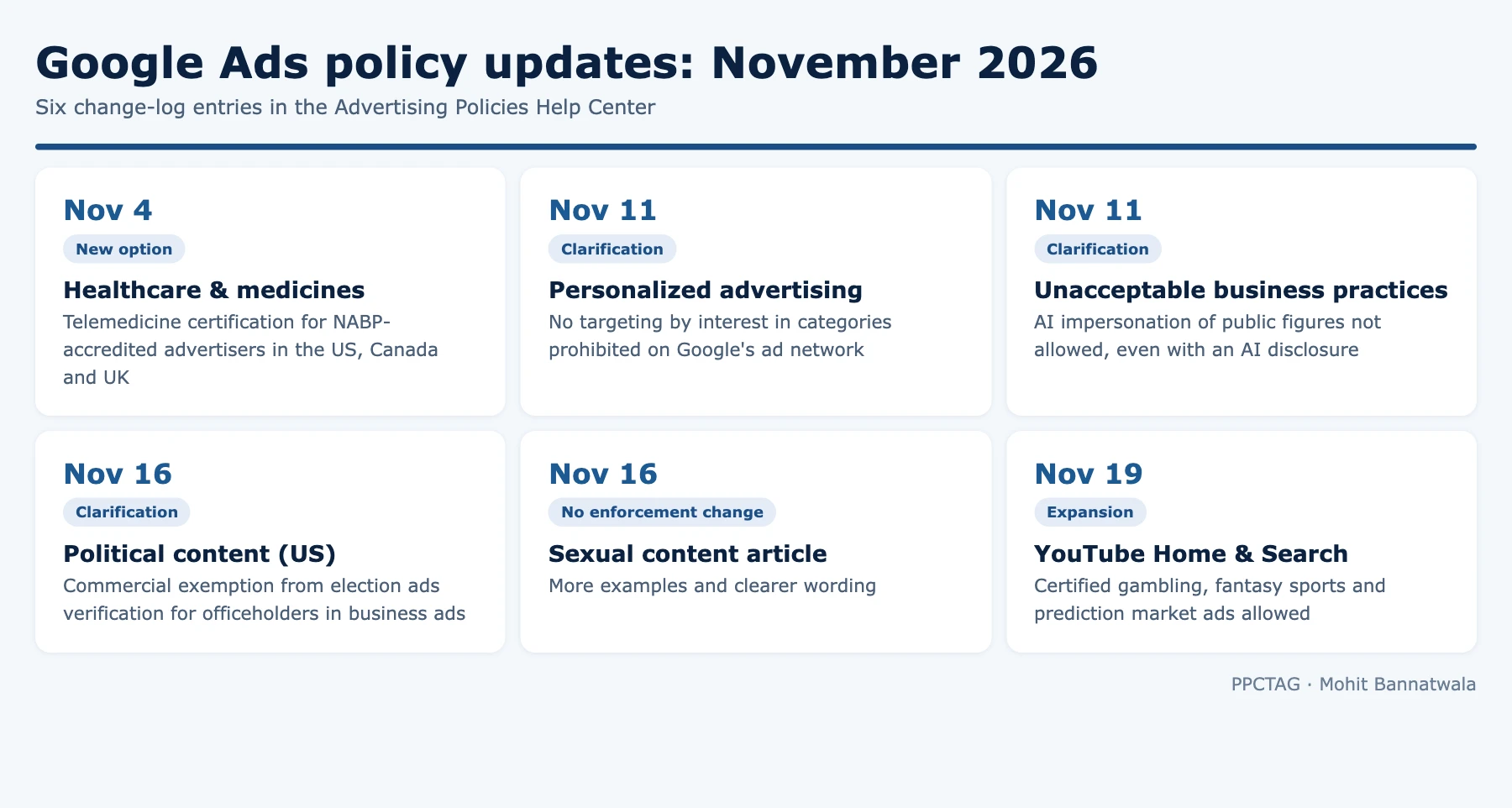
Google records every policy change in the Advertising Policies Help Center change log. In November 2026 it added these entries:
| Date posted | Policy | What changed | Type of change |
|---|---|---|---|
| November 4 | Healthcare and medicines | New telemedicine certification option for NABP-accredited advertisers (US, Canada, UK) | New option |
| November 11 | Personalized advertising | No targeting by interest in categories prohibited on Google’s ad network | Clarification |
| November 11 | Unacceptable business practices | AI impersonation of public figures not allowed, even with AI disclosure | Clarification, no enforcement change |
| November 16 | Political content (US election ads) | Commercial exemption from election ads verification | Clarification |
| November 16 | Sexual content article | More examples and clearer wording | No enforcement change |
| November 19 | YouTube Home and Search ad requirements | Certified gambling, fantasy sports and prediction market ads allowed on YouTube Home and Search | Expansion |
1. Personalized advertising: no targeting by prohibited interests
Google’s Restricted targeting in Personalized advertising policy now includes one extra sentence: advertisers are not allowed to target users based on an interest in categories that are prohibited in Google’s ad network. Prohibited content is the set of things you can’t advertise at all, such as counterfeit goods, dangerous products or services, and dishonest behavior like hacking services or fake documents.
In practice this matters most for custom segments and keyword-based audience signals. If you build a segment from search terms or websites tied to prohibited content, Google can treat the targeting itself as a violation, even if your ad and landing page are clean.
The rest of the policy is unchanged, but it’s worth a reminder because it trips up local businesses often:
- Sensitive interest categories (health, alcohol, gambling, negative financial status, relationship hardships and others) can’t use advertiser-curated audiences: Customer Match, your data segments, audience expansion or lookalike segments. Google’s predefined audiences, such as in-market and affinity, are still allowed.
- Access to opportunities categories in the US and Canada (housing, employment and consumer finance) can’t target by age, gender, parental status, marital status or ZIP code. Radius and city targeting are fine, with a radius of at least 1 km.
- Negative remarketing lists can’t be used as a back door for positive personalization.
2. AI impersonation of public figures isn’t allowed, even with a label
The Unacceptable Business Practices policy already banned pretending to be a public figure, or implying a public figure endorses you, to get people’s money or personal information. Public figures include government officials, entertainers, athletes, online influencers and well-known business people.
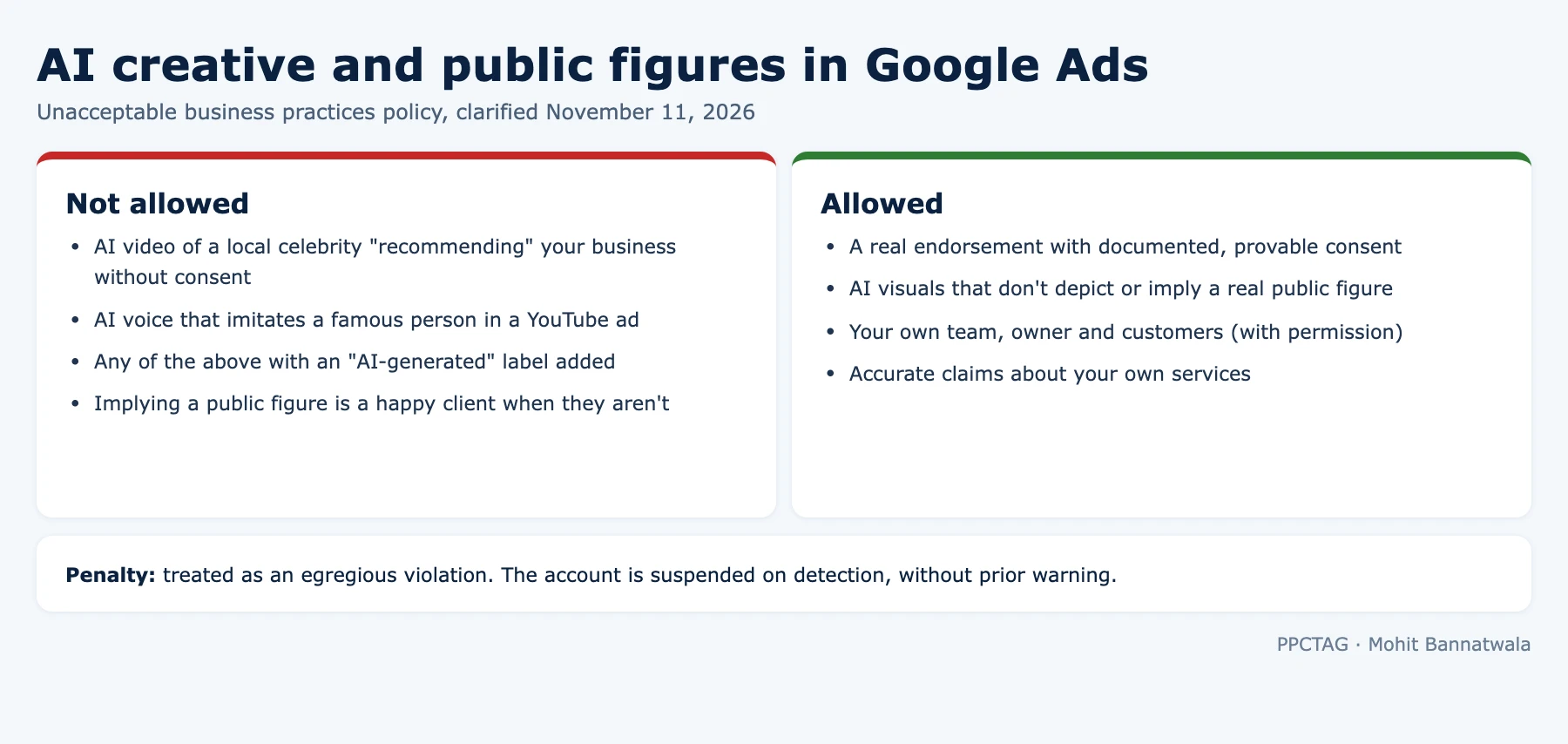
Google has now added a note: ads that impersonate public figures using AI are not allowed, even if they disclose that they were generated or edited using AI. Google says this clarifies the policy and does not change enforcement.
Enforcement is strict. Google treats unacceptable business practices as an egregious violation, which means the account is suspended when the violation is detected, without a prior warning. Reinstatement only happens in compelling circumstances, such as a genuine mistake.
For local businesses the risk usually comes from creative, not intent. Examples to avoid:
- An AI video of a local sports star or TV personality “recommending” your roofing company, without a signed agreement.
- An AI voice that sounds like a well-known celebrity in a YouTube ad for a med spa or dental practice.
- A testimonial-style image of a famous influencer generated with AI for a home services promotion.
If a public figure really does endorse you, Google’s best practice is to keep documented consent, and be ready to share contracts or public statements in an appeal.
3. Telemedicine: a new certification route (US, Canada, UK)
Telemedicine ads in many countries need Google certification before they can run. From November 2026, the Canada, United Kingdom and United States sections of the Healthcare and medicines policy add a new option: telemedicine advertisers accredited through the National Association of Boards of Pharmacy (NABP) Healthcare Merchant Accreditation Program can apply for Google Ads telemedicine certification.
- It is an additional route. Existing certification options are not affected.
- You must hold the NABP accreditation before you apply to Google.
- Applications open once Google publishes the updated policy. Google gave November 2026 as the timing but no exact day.
This is relevant for clinics, med spas, weight-loss practices and dental groups that offer virtual consultations alongside in-person visits. If your telehealth ads have been held back by certification, check whether NABP accreditation is a faster path than the options you were using.
4. Political content: when an officeholder appears in a business ad
Under the US election ads section of the Political content policy, ads that feature a current officeholder or candidate usually need election ads verification. Google has clarified two commercial exemptions. Ads are exempt when the officeholder or candidate appears only:
- in connection with a legally established government program, or
- as a commercial employee or agent offering products or services for sale,
and the ad makes no reference to their political office, party or campaign.
This comes up more often in local advertising than you might think. A plumbing company owner who sits on the city council, a real estate agent running for county commissioner, or a lawyer who is a state representative can appear in their own business ads without election ads verification, as long as the ad is about the business and says nothing about the office or the campaign. Add “Councilman” to the headline or a campaign slogan to the video, and the exemption no longer applies.
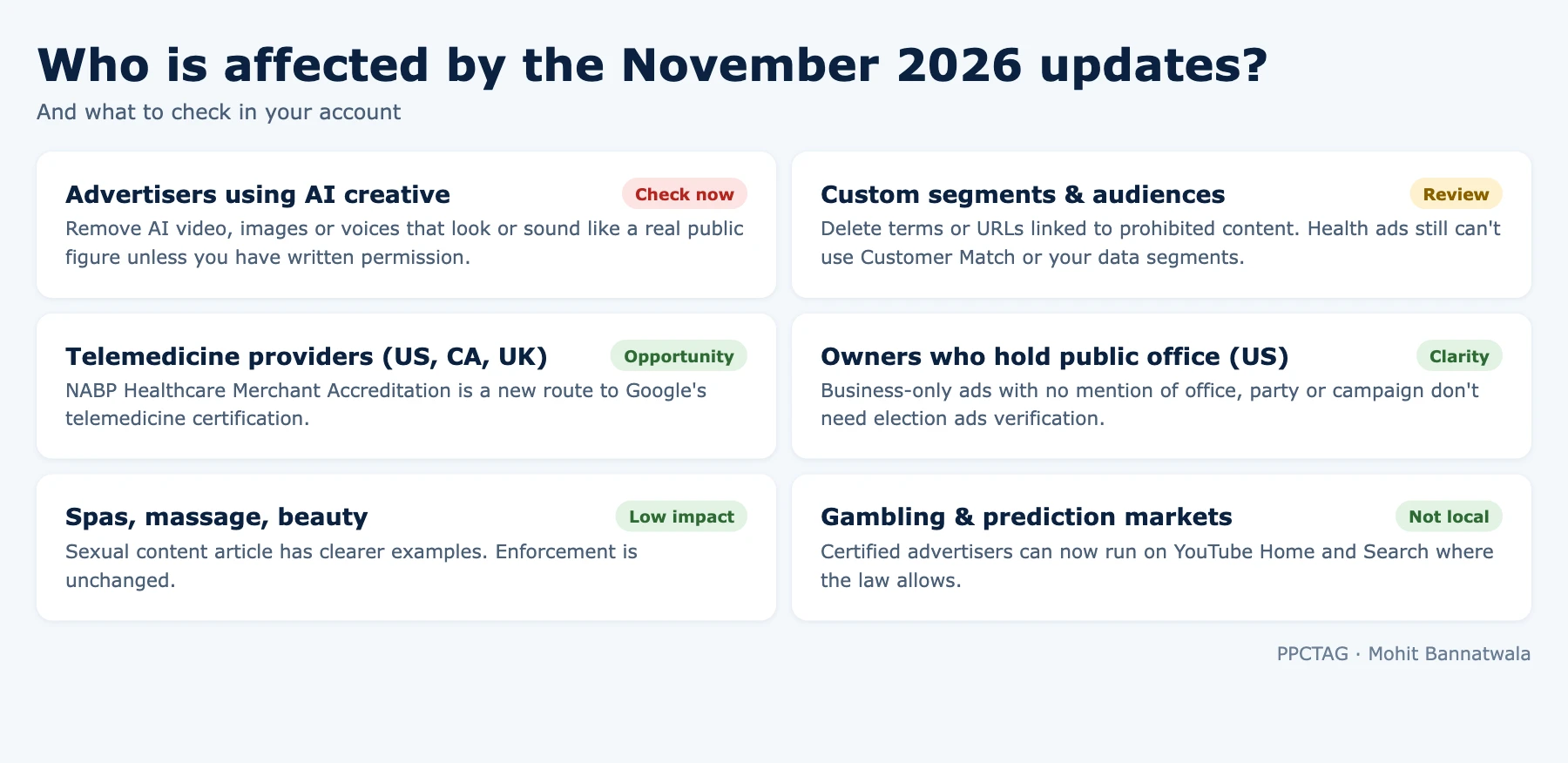
5. The smaller updates
- Sexual content policy article (November 16): Google added examples and clearer wording. Enforcement doesn’t change. Spas, massage and some beauty businesses may still want to reread it, as the examples help explain where ads get restricted.
- YouTube Home and Search (November 19): certified online gambling advertisers, certified fantasy sports advertisers targeting the US or Canada, and certified prediction markets advertisers can now advertise on YouTube Home and Search where the law allows. This doesn’t affect local service businesses.
What it means for local service businesses
Most local accounts won’t see any change from these updates. A short check is still worth doing:
- Review custom segments. Open Tools > Shared library > Audience manager and look at custom segments built from search terms, URLs or apps. Remove any terms linked to prohibited content.
- Check audiences in sensitive categories. If you advertise health services, such as dental practices, make sure campaigns that promote treatments don’t rely on Customer Match or your data segments in ways the policy doesn’t allow.
- Audit AI creative. Look at every AI-generated video, image and voice-over in Performance Max, Demand Gen and YouTube. Remove anything that looks or sounds like a real public figure unless you have written permission.
- Check owner-led ads. If the owner holds or is running for office, keep the ads strictly about the business. This is common with law firms and real estate.
- Telehealth providers: look into NABP accreditation if your current certification route is slow.
Policy problems hit local businesses hard because a single suspended account can stop all leads overnight. If you also run Local Services Ads, your Google Verified badge depends on staying in good standing too.
PPCTAG’s take
None of these updates is a reason to panic, but the AI impersonation note deserves attention. AI video and voice tools have made it easy to produce “celebrity-style” creative in minutes, and some agencies treat an “AI-generated” label as a safe harbour. Google has now said clearly that it isn’t. Because the penalty is suspension without warning, we would rather remove a borderline asset than test it.
The personalized advertising change is mostly about bad actors, but it is a good prompt to clean up old custom segments that nobody has looked at in a year. And the political content clarification removes a real headache for owner-operators who serve their community in local government: they can now appear in their own ads with confidence, as long as the ad stays about the business.
FAQs
What Google Ads policies changed in November 2026?
Google updated the Healthcare and medicines policy (telemedicine certification), the Personalized advertising policy, the Unacceptable Business Practices policy (AI impersonation), the Political content policy (US commercial exemptions), the Sexual content policy article and the YouTube Home and Search ad requirements.
Can I use AI to create an ad with a celebrity if I label it as AI?
No. Google says ads that impersonate public figures using AI are not allowed, even if they disclose that the content was generated or edited using AI. You need the public figure’s documented permission to suggest they endorse you.
What happens if my ad breaks the public figure impersonation policy?
Google treats it as an egregious violation. Your Google Ads account is suspended when the violation is detected, without prior warning. You can appeal if you believe it was a mistake, but accounts are only reinstated in compelling circumstances.
Does a business owner who holds public office need election ads verification?
Not if the ad features them only as a commercial employee or agent offering products or services, or in connection with a legally established government program, and makes no reference to their office, party or campaign.
How can telemedicine providers get Google Ads certification now?
In the US, Canada and the UK, providers accredited through NABP’s Healthcare Merchant Accreditation Program can apply for Google’s telemedicine certification once the updated policy is published. They must have the NABP accreditation before applying. Existing certification options still apply.
Worried that a policy issue could switch off your leads? We’ll review your audiences, creative and account health and tell you what to fix first.
Sources
- Advertising Policies Help: Update to the Personalized Advertising Policy (November 2026)
- Advertising Policies Help: Restricted targeting in Personalized advertising
- Advertising Policies Help: Updates to Unacceptable Business Practices (November 2026)
- Advertising Policies Help: Unacceptable business practices
- Advertising Policies Help: Update to Healthcare and Medicines Policy (November 2026)
- Advertising Policies Help: Update to Political Content policy (November 2026)
- Advertising Policies Help: Update to Sexual Content policy article (November 2026)
- Advertising Policies Help: Updates to YouTube Home and Search Ad Requirements (November 2026)